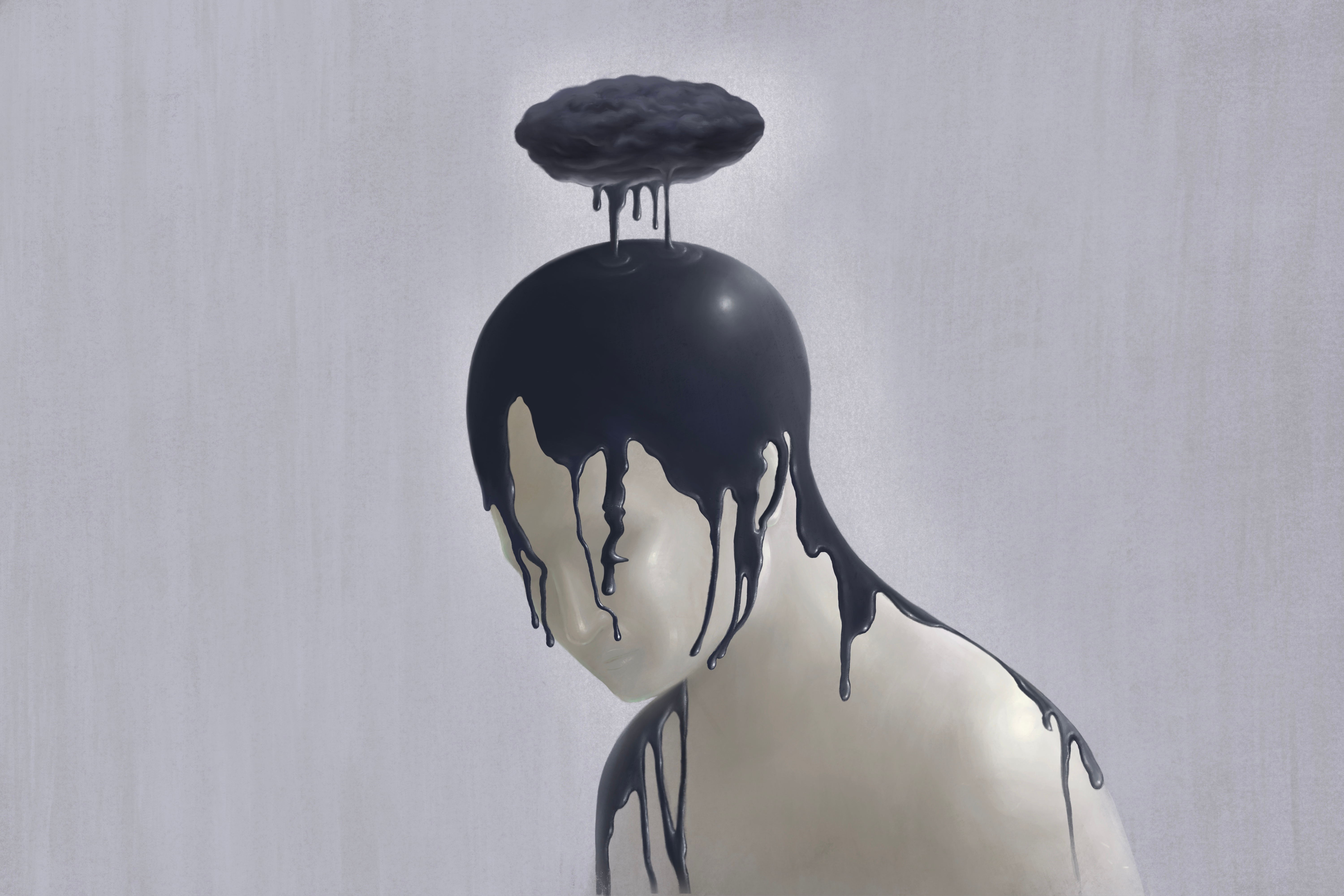

Today’s topic fits the gloom outside: negative self-talk. In this post we’ll be talking about inner critics, negative self-thoughts and limiting self-beliefs. And if these matters seem daunting, that makes sense, they are. Light some candles, warm your hands to your teacup, and we’ll tackle them together.

Defining ‘Self-Talk‘
I don’t think we need a dictionary definition of the word talk, so let’s just skip right ahead to my proposed definition for self-talk: ‘the way one speaks to or about oneself, either aloud or in one’s mind’.
The way you talk to and about yourself can impact a lot of things. It can influence how you approach life, if you dare to take risks and are unafraid of making mistakes or if you feel trapped in a cage of insecurity and incompetence. Most people are not naturally kind to themselves, but the good news is that this can be learned with practice. But before we jump into all the ways we can lift ourselves up, we firstly have to unlearn bringing ourselves down.
The Parasite
We as humans are natural storytellers. That’s why we love music, films, plays and other types of art. Every one of us has an inner voice, a narrator that comments on our daily activities and creates stories about ourselves. Whether we are aware of it or not, we talk to ourselves all day. And since the human brain is hard-wired for negativity, most of us spend more time beating ourselves up than complimenting ourselves. In his book The Mastery of Self, Don Miguel Ruiz Jr. calls this negative narrator ‘the Parasite’, since it can make you believe the worst about yourself. Negative self- beliefs affect your self-image, your actions and ultimately your life. But the negative voice in your head isn’t actually you. You can choose to disagree with it. But first, of course, you have to learn to spot the parasite.
Inner critics
It can be helpful to categorise the Parasite into smaller parts, namely into several inner critics. These are the voices in your head that make you doubt, judge and/or pity yourself, and just make you feel less confident overall. Psychotherapists Jay Earley and Bonnie Weiss acknowledge 7 different types of inner critics:
- The Perfectionist: the voice that has unreasonably high standards for everything you do, in order for you to not get criticised by others
Example: “You can sleep when you memorised the entire presentation by heart.” - The Inner Controller: the voice that tries to control any impulsive or spontaneous behaviour including eating, drinking, spending and sex, while always being in fear of you getting out of control
Example: “Don’t buy those cookies, because you’ll eat one and then you’ll eat all of them and you’ll eat your entire fridge.” - The Underminer: the voice that tries to undermine your self-esteem so that you don’t take risks, in order to keep you ‘safe’ from the embarrassment of failure, rejection and judgement
Example: “Don’t participate in that open mic, you’ll make a fool of yourself.” - The Taskmaker: the voice that pushes you to work non-stop in order to be successful, without taking any time out for rest or play
Example: “You better use the weekend to catch up on those reports you couldn’t finish today.” - The Guilt Tripper: the voice that keeps repeating past mistakes to you in order to teach you not to make them again, keeping you stuck in the past
Example: “Remember how embarrassing it was when you asked that person out and they rejected you?” - The Molder: the voice that tries to shape you according to societal, cultural or family norms, in order to be liked and accepted, but keeping you from being authentic
Example: “If you’d lose a few pounds you’d be a lot prettier.” - The Destroyer: the voice that tries to make you believe you add no value, that you should not exist and don’t deserve love or respect
Example: “You don’t have any friends, nobody likes you.”
How to deal
So how do we deal with these inner critics? What we have to realise is that we have the option not to believe what these voices are telling us. They don’t have to become our truth. When you notice a negative thought you have about yourself, you can open up a dialogue. You can ask a series of questions. Artist Abria Joseph uses these three: 1. Is is the truth? 2. Is it necessary? 3. Does it improve upon the silence?
My own therapist gave me these: 1. Is it true? 2. Are you absolutely sure it’s true? 3. How do you feel when you think it’s true? 4. Who would you be without that belief?
For some negative self-thoughts the ‘Is it true’-question doesn’t work that well, like in the example from the Perfectionist. What’s more helpful in that case is to ask yourself: Would I say this to a close friend or a beloved family member? The answer will most likely be no, so why say it to yourself?
It doesn’t really matter which system you use, the point is to become aware of the fact that these thoughts are just that: thoughts. And what’s great about thoughts is that they can change.
Changing your story
The beautiful thing about storytelling is that you can comprise a hundred different stories using the same events. It’s all about perspective, focus points and choosing what’s worthy of being told. We can change our personal stories by thinking about how we tell them and then actively making the decision to rewrite them. Let me illustrate this with a personal example.
Ever since I received a very low grade on my first uni essay, I concluded I was just not good at academic writing, and that I never would be. Over the last six years I’ve been telling myself I’m bad at seeing the whole picture, connecting the dots and drawing conclusions that follow logically from what I’ve been writing about. And this became a self-fulfilling prophecy. For almost every paper I wrote, I received pretty negative feedback, which made me anxious for the next time I had to write something, which made me believe in my own capabilities less. And doing something without confidence doesn’t often bring great results. Writing my BA thesis was hell, and my feedback was even more brutal than I imagined. Belief confirmed.
But next semester I’m starting on my MA thesis and I knew I didn’t want to go into that process with the prospect that it would just be hell again. So I questioned my own belief that “I am just not good at academic writing”.
1. Is it true? Yes, it’s because of my ADD.
2. Are you absolutely sure it’s true? Well actually no, because I did write one hell of a paper about fear in The Plot against America, which my professor was very enthusiastic about.
3. How do you feel when you think it’s true? Like an incompetent mess who’s going to have a very unpleasant next half year.
4. Who would you be without that belief? An intelligent young woman who’s about to be graduated so that I can start doing what I like for actual money.
So, I decided to let that belief go and repeated this mantra for myself for a while: “I got this far into my MA and I’ve learned a lot from writing my BA thesis, so I am perfectly capable of writing my MA thesis without any stress.” And with that mindset, I started doing the research for my topic, and found I actually enjoyed myself a little bit! Who’d have thought. I feel ready to do this and I choose to believe I will crush it. So even though my inner critic (I think this would be The Guilt Tripper) used certain facts to make me believe I’m just always going to be bad at essay writing, I took back control of narrative with different facts and a new attitude. And you know how that makes me feel? Free and confident. And you deserve to feel free and confident as well.
Exercise of the day
Identify which inner critic is loudest for you. Choose a specific thought it tells you or a certain belief it has instilled in you. Then ask yourself either of the two sets of questions and see if you can let that belief go or if you can change it.


Great points. I myself find that action helps me more than mental exploration, so things like exercising, taking care of anything that’s bugging me, or simply walking help a lot. Anyway, thanks for this post!
LikeLiked by 1 person
Thank you! That makes sense, movement works really well for me too 🙂 Though sometimes certain thought patterns have to be addressed so we can change them I believe!
LikeLike
I’m so proud of you. It is such a good piece of writing with great advice. I really like the personal example and the additional set of questions to explore the thought. I also dealt a lot with negative self-talk, and my therapist taught me two types of negative talk, that I found a little more intuitive. They divided those negative thoughts between either the critic or the demander. The demander is like the perfectionist raises an unrealistically high bar and the critic is the bully that makes you feel bad when you inevitably fail. For example: “I have to look perfect during this party and socialize with everyone”. This obviously puts a lot of pressure on the event. Afterwards “You are unattractive, because you’re make-up started running, and nobody liked you, because you were to awkward to talk to people.” Making you feel terrible.
I wanted to share this for anyone who might benefit from it. Anyway, great post. So proud of you ❤
LikeLiked by 1 person
Thank you so much, darling! And thanks for sharing ❤
LikeLike